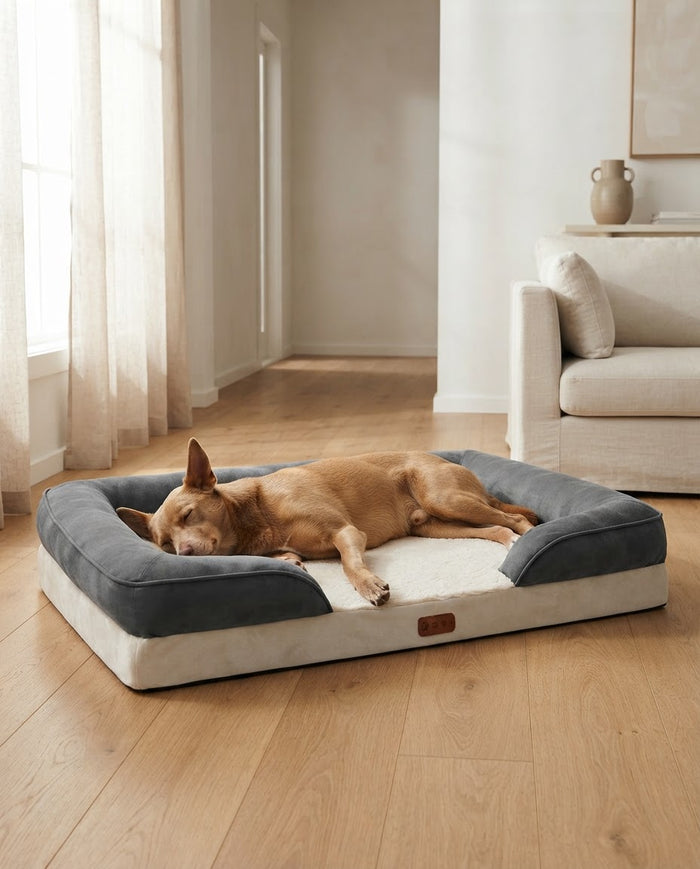
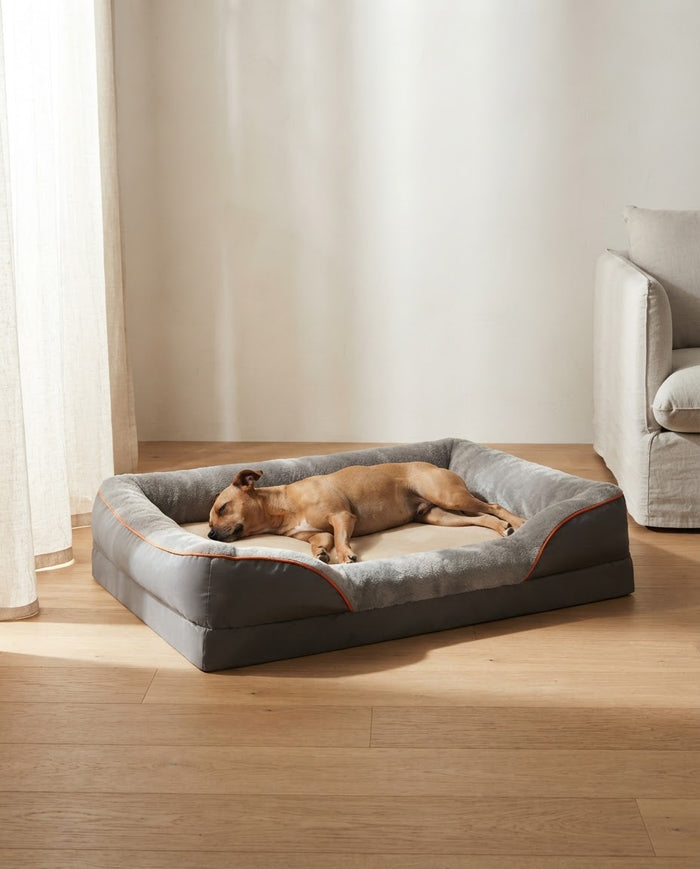
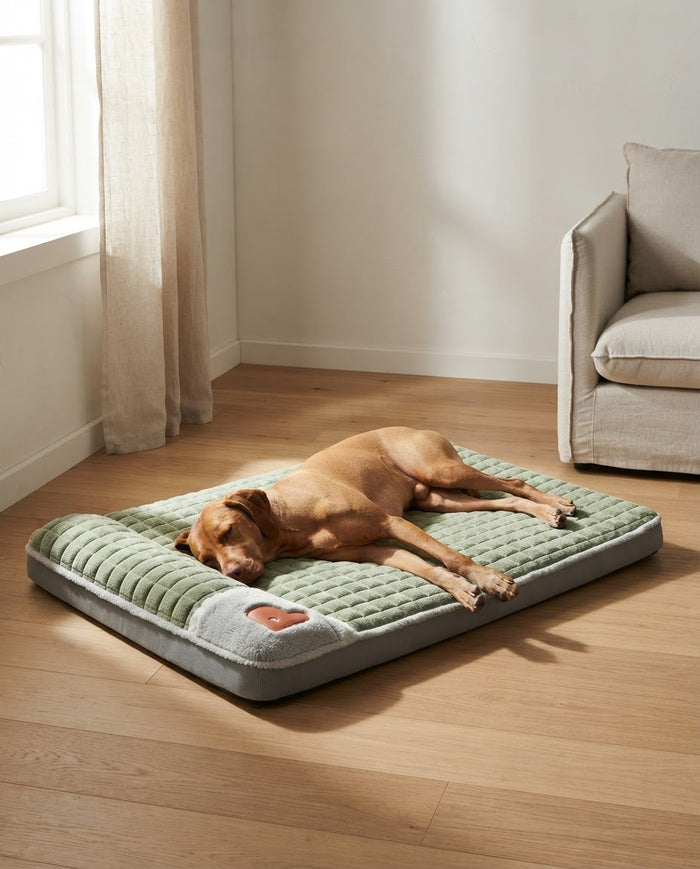
The word
“Orthopaedic” is not a regulated word.
There is no standard a bed has to meet before the label goes on the box, no body that checks, and no penalty for using it loosely.
Anyone can print it on a bag of polyester stuffing, and plenty do. So the word on its own tells you nothing. Here is what it is supposed to mean, what we mean by it, and how to judge any bed sold under it — including ours.

Two ways to fill a dog bed. Only one keeps working.
A supportive foam base
A slab that resists compression and returns to shape when the dog gets up. It does not feel as soft under your hand. It is doing something different — holding a surface at a consistent height above the floor.
Loose filling
Polyester fibre or shredded foam poured into a cover. Excellent in the shop, because nothing resists you when you press it. That is exactly the problem.
Under a dog's weight, night after night, loose fill compresses and then migrates sideways. Within weeks it has moved to the edges, leaving a hollow precisely where the weight goes and a rim of unused material around the outside.
Returning to shape and staying level is the whole of what the word is meant to describe.
The failure has a name: bottoming out
A dog's weight does not spread evenly across a bed. It concentrates at the hips and shoulders, which is why those are the spots that wear through a cheap bed first.
Bottoming out is when the bed compresses so far under a pressure point that the dog is effectively resting on the floor through it. A bed can look completely intact and still be bottoming out — the cover is fine, the shape is fine, and the surface underneath has quietly stopped doing its job.
This is why depth and recovery matter more than softness. A thin, very soft bed bottoms out immediately. A firmer, deeper one does not — and it will feel less plush in the shop while being the better bed six months later.
What we publish, and what we don't
Foam density — kilograms per cubic metre — is the figure that predicts whether a base is still working in a year. It is also the number almost no pet retailer prints, because it requires the manufacturer to tell you and requires you to believe them. Thickness gets published instead, because it is easy to measure and sounds impressive.
Here is exactly where our seven orthopaedic beds stand today.
| Bed | External dimensions | Foam thickness | Foam density |
|---|---|---|---|
| The Ridge | ✓ Published | – In progress | – In progress |
| The Hollow | ✓ Published | – In progress | – In progress |
| The Flat | ✓ Published | – In progress | – In progress |
| The Burrow | ✓ Published | – In progress | – In progress |
| The Loft | ✓ Published | – In progress | – In progress |
| The Fold | – In progress | – In progress | – In progress |
| The Plain | – In progress | – In progress | – In progress |
Published means the figure is on the product page today. In progress means we have asked the manufacturer and are waiting on a figure we can evidence. We would rather show you the gap than fill it with a number we cannot stand behind — and we would rather you saw this table than took our word for it.
Six questions for any orthopaedic bed
They work on our beds and on everyone else's, and the answers are more informative than the label.
- Is the base foam, or is it filling?If the listing says plush, fluffy or filled and never says foam, it is filling.
- What is the foam density, and can they evidence it?If the answer is a number with no test report behind it, treat it as marketing.
- How thick is the foam base?Not the height of the bed including its rim — the slab your dog actually lies on.
- What is the entry height at its lowest point?The one that matters most for a stiff dog, and the one almost nobody lists.
- What is the usable sleeping area, as distinct from the external footprint?A rim can take ten to twenty centimetres off every edge.
- Does the cover come off completely?A bed usually outlasts its first cover. If the cover cannot be removed, the bed's life is the cover's life.
What we will not tell you
We will not tell you that a bed treats arthritis, hip dysplasia, joint pain, or anything else. That is a therapeutic claim, it belongs to your vet, and no bedding retailer is in a position to make it.
What we will say is mechanical and checkable: a supportive base keeps your dog off a hard floor and stops them sinking through to it, and a low front means they are not climbing over a rim several times a day. Those are the two reasons owners of older and stiffer dogs buy these beds. What follows from that for your particular dog is a conversation to have with your vet, not with us.
If a store tells you a bed will fix your dog's hips, that is the moment to be more sceptical, not less.
The beds that pass our own test
Every one of these has a supportive foam base rather than loose filling. That is the only reason we use the word.